Department of Public Health


Data is Everywhere. Insight is Rare.

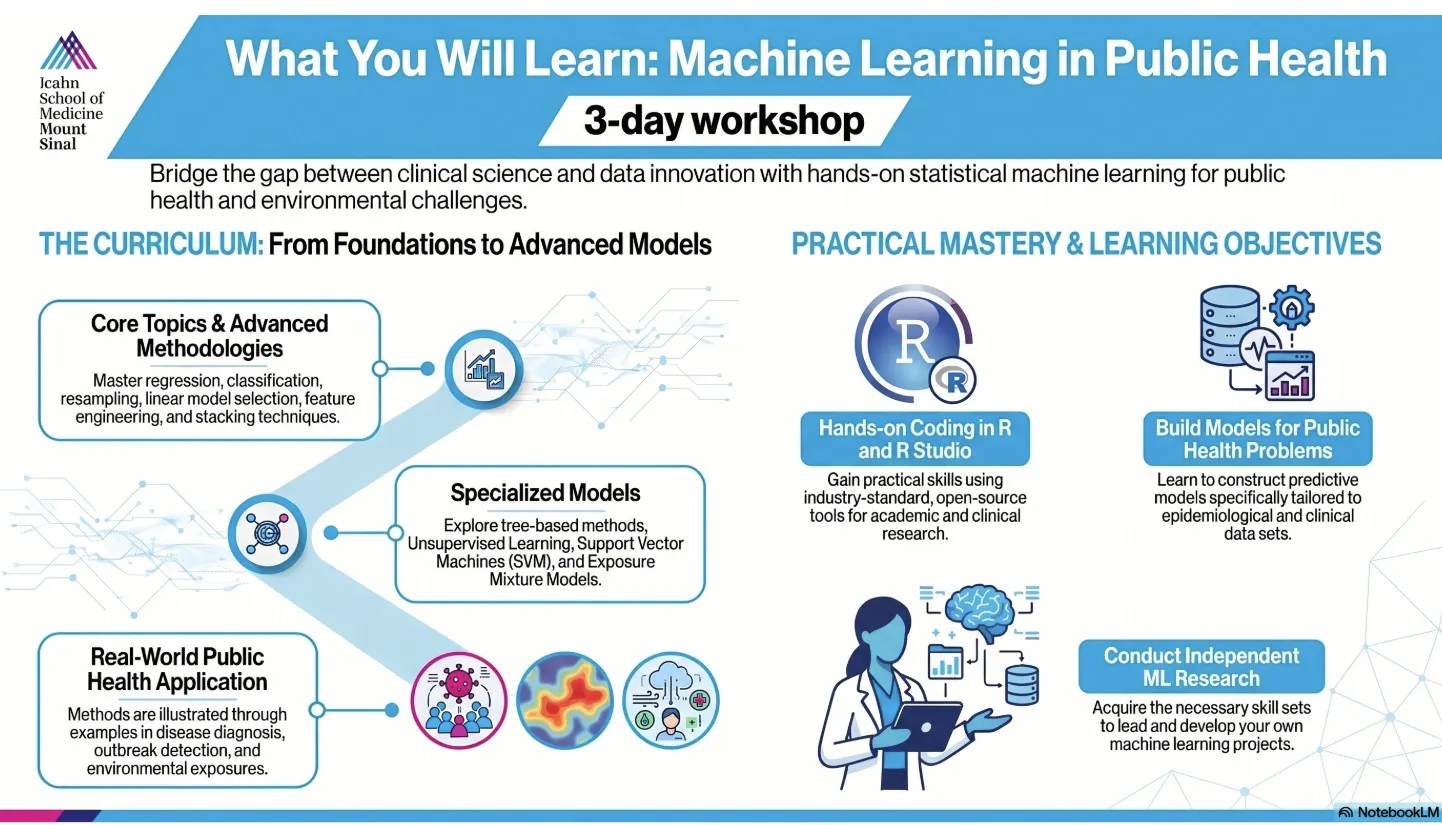
From predicting disease outbreaks to identifying patterns in environmental exposures, Machine Learning (ML) is no longer a "future technology"—it is an essential tool for the modern health researcher. This workshop bridges the gap between raw data and actionable public health solutions.


Why this workshop?

  • The Power of Prediction: Move beyond traditional statistics to build models that forecast outcomes.
  • Competitive Advantage: Gain the technical literacy required for high-impact publishing and modern research grants.
  • Transdisciplinary Application: Learn use cases ranging from disease diagnosis to climate-related health risks.

Learn by Doing. Leave with Results.

Led by Vishal Midya, PhD, this is a hands-on technical workshop. We bypass the "black box" of AI, teaching you the statistical foundations and the practical coding skills needed to conduct independent research.


You should have some proficiency in R and R Studio.

  • Technical Requirements: While we focus on making ML accessible, this is a "keyboard-on" workshop. Participants should have:
    • Software Proficiency: A working knowledge of R and R Studio.

    • Foundational Knowledge: A basic understanding of epidemiology and biostatistics.
    • Equipment: A laptop with R and R Studio pre-installed (setup guide provided upon registration).

Curriculum Highlights

  • Regression & Classification: The foundations of predictive modeling.
  • Tree-Based Methods: Master Random Forests and decision trees.
  • Supervised Learning: Discover hidden clusters in population health data.
  • Feature Engineering: Learn to prepare "messy" real-world data for high-performance models.

Learning Objectives

By the end of this workshop, participants should be able to:

  • Build basic machine-learning models to solve public health problems.
  • Have an advanced understanding of machine-learning methods, specifically when to use one and when not to use one.
  • Understand the statistical underpinning of the models and how they can be modeled to address a public health problem.
  • Have the knowledge and skill sets to develop and conduct their machine learning research projects independently.

$1,000/pp (3-day total) Click below to register and submit payment. *Possible funding support opportunity: Potential & limited CTSA funding support may be available for eligible faculty and post-docs (not on a T1, T32, etc. grant). This requires a separate statement. Eligibility and approval will be determined by the Dean and Chair for the Department of Public Health. Apply by June 26 (details on registration form).

 $1,200/pp (3-day total) Click below to register and submit payment.

Special discounted rate: $250/pp. Click below to register and submit payment. 
*Potential CTSA funding for students may be available. Approval by the Dean and Chair for the Department of Public Health. Apply by June 26 (details on registration form)